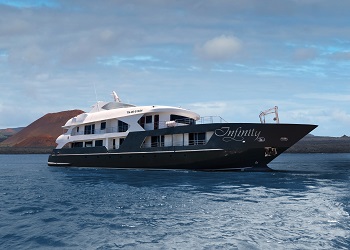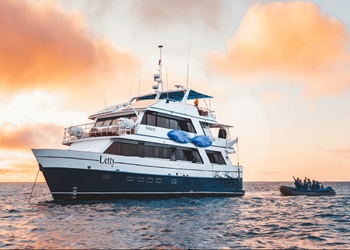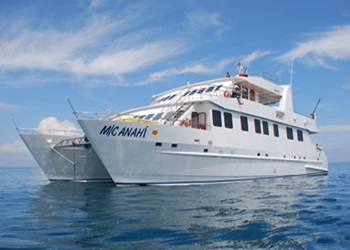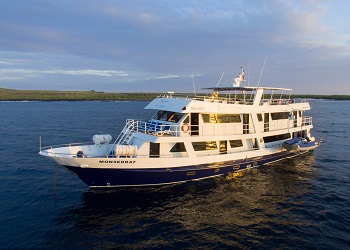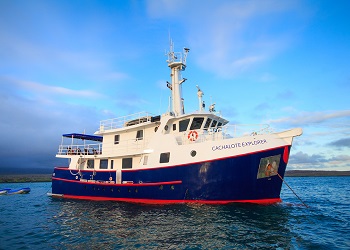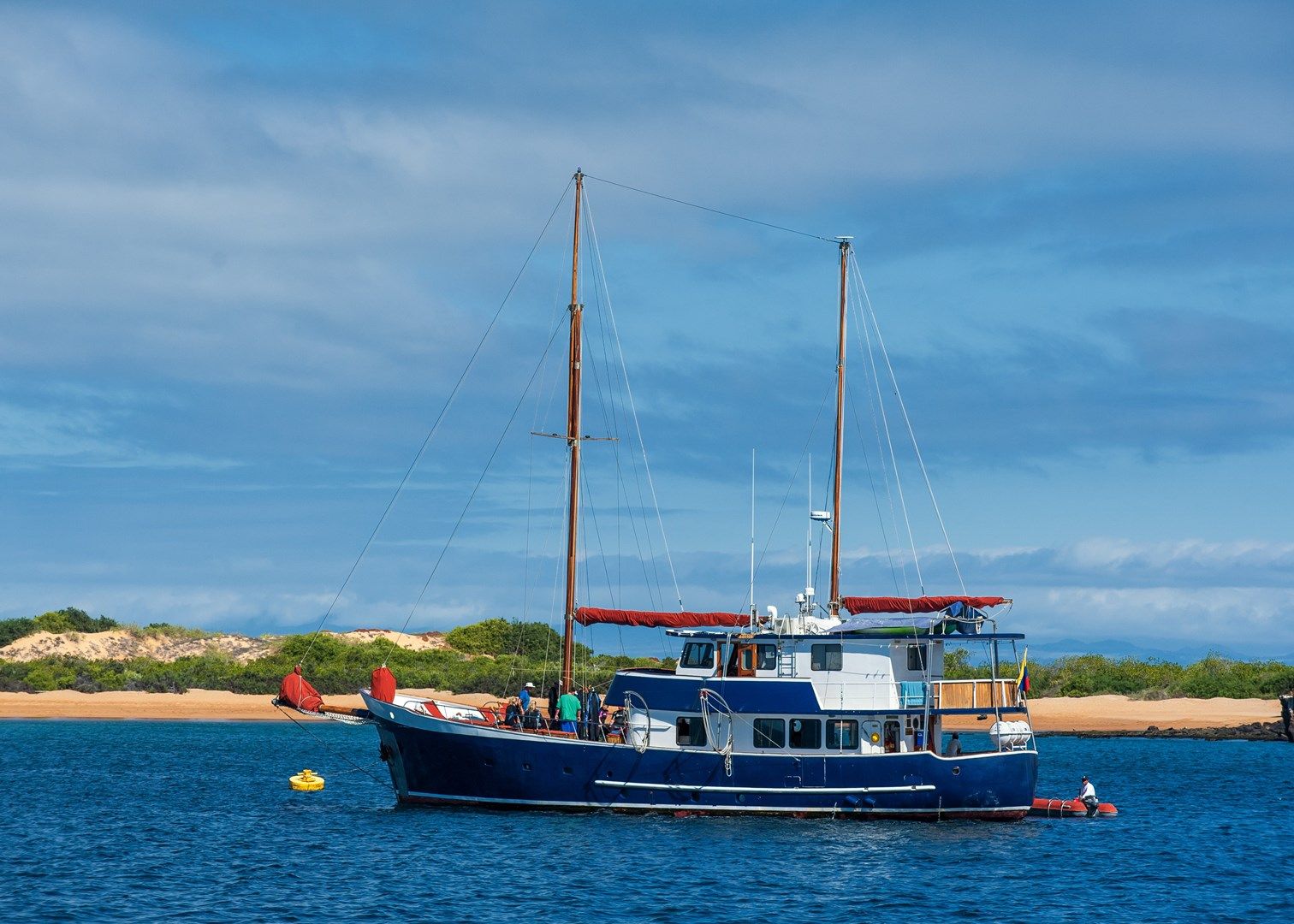
Yolita Itinerary B - 8 days
ITINERARY B - 8 DAYS
SUNDAY
AM: Baltra: Arrival and Transfer to the boat
PM: North Seymour (HK)
MONDAY
AM: San Cristobal: Kicker Rock / Witch Hill (HK/SN/PR)
PM: San Cristobal: Lobos Island (HK/SN/PR)
TUESDAY
AM: Espanola: Gardner Bay (HK/SN/PR)
PM: Espanola: Suarez Point (HK)
WEDNESDAY
AM: Santa Fe (HK/SN/PR)
PM: South Plazas (HK)
THURSDAY
AM: Santa Cruz: Charles Darwin Station (HK)
PM: Santa Cruz: Highlands (HK)
FRIDAY
AM: Floreana: Cormorant Point / Devil's Crown (SN/HK/PR)
PM: Floreana: Post Office Bay (HK/SN)
SATURDAY
AM: Chinese Hat (HK/SN)
PM: Santa Cruz: Dragon Hill (HK)
SUNDAY
AM: Santa Cruz: Black Turtle Cove (PR)
Baltra: Transfer to the Airport
HK: HIKE / SN: SNORKEL / PR: PANGA RIDE / KY: KAYAK /
PB: PADDLE BOARD
DAY 1: SUNDAY
AM: BALTRA ARRIVAL AND TRANSFER TO THE BOAT
At the arrival hall a naturalist guide will meet you and escort you on a short bus ride to the harbor at Baltra. By dinghy you will be taken to the yacht.
PM: NORTH SEYMOUR
North Seymour is an uplifted (different to volcanic origin) island and so is generally flat and strewn with boulders. There are good nesting sites here for a large population of magnificent frigate birds. Blue-footed boobies perform their courtship dance in the more open areas and swallow-tailed gulls perch on the cliff edges. Despite the tremendous surf that can pound the outer shore, sea lions haul out onto the beach and can be found bodysurfing.
Watch your step, as the boobies don't worry much about where they nest, and you might just step on one. The trees are dotted with male frigate birds trying to attract the attention of the ladies by inflating their bright red skin flaps (seasonal activity). They sometimes fly in the air to call more attention to themselves. There's a circular path that takes you through the island to a beautiful, rocky shore where the waves crash with a silvery-blue color.
DAY 2: MONDAY
AM: SAN CRISTOBAL: WITCH HILL - KICKER ROCK
Cerro Brujo (Wizard Hill) is a beautiful beach made of white coral and volcanic ash. It is located along the north coast of San Cristobal, the island where Charles Darwin first arrived in September 1835. Cerro Brujo is an eroded tuff cone and several parts are composed of the AA lava type. In this fascinating landscape you can observe sea lions, as well as different sea birds, finches and warblers. The sheltered bay is popular for young sea turtles and rays. The salt water pools behind the sand dunes were used as a salt mine in the past. After visiting Cerro Brujo you will continue by yacht to Leon Dormido (Kicker Rock). This huge ‘cathedral’ of rock is an old lava cone, now split in two. On the rocks many blue footed boobies, Nazca boobies and frigate birds are to be found. The snorkeling is great here, with good opportunities for seeing sea turtles, spotted eagle rays, tropical fish and the Galapagos shark.
PM: SAN CRISTOBAL: LOBOS ISLAND
This little island is not far off Port Baquerizo Moreno, the capital of the Galapagos Islands and the main town of San Cristobal. The trail will lead across a dry vegetation zone, substrate of volcanic rocks and sandy areas. There is a small population of blue-footed boobies and frigate birds, which nest in this site. At the beach you will see a large colony of sea lions. It is common to see shorebirds.
DAY 3: TUESDAY
AM: ESPANOLA: GARDNER BAY
Located on the north-eastern coast of Hood, Gardner Bay provides an excellent beach for relaxing, swimming and snorkeling, and the opportunity to observe sea lions. Here you may also observe sharks in the crystal clear ocean waters.
PM: ESPANOLA: SUAREZ POINT
This rocky land spot sustains one of the most impressive and varied colonies of sea birds in the Galapagos. Along its southern shore, high cliffs rise up from the sea affording the visitor spectacular views of soaring birds and of the blow whole where water spouts up to 50-75 feet into the air according to the intensity of the surf.
DAY 4: WEDNESDAY
AM: SANTA FE
Located in the southeastern part of the Galapagos, this island was formed from an uplift, which explains why it is mostly flat. There are some theories which assure this could be the oldest island in the Archipelago. Santa Fe is the home of a number of endemic species like the Galapagos Hawk, Galapagos snake, Galapagos mockingbird, rice rats and one of the two species of lands Iguanas of the islands. After disembarkation in the beautiful and clear waters you will be in contact with one of the many sea lion colonies. Along the trail many salt bushes can be seen as well as giant pickly pear cactus. There are great possibilities of snorkeling with playful sea lions and tropical fishes.
PM: SOUTH PLAZAS
South Plazas is located at the east of Santa Cruz Island, and forms part of two islands known as Islas Plazas. Despite its small size, some of the most interesting and outstanding species of the Galapagos are found here. The Plazas land iguanas are smaller than its relatives found on other islands. Throughout the island there are several hybrid iguanas, a result of crossing a male marine iguana and a female land iguana, they are unique, recognizable at first glance by their black/gray color, with a land iguana's crest, but face and tail of the marine iguana. The big population of iguanas is due to the presence of tunas, their favorite food. Swallow Tailed Gulls nesting in the rugged cliffs are seen along with other sea birds as: Audubon shearwaters, red-billed tropicbirds, frigate birds and brown pelicans.
DAY 5: THURSDAY
AM: SANTA CRUZ: CHARLES DARWIN STATION
Although the great majority of Galapagos visitors come here to observe and appreciate natural wonders, it is also interesting to learn how the protection and conservation of the islands are carried out. The Breeding and Rearing area of the scientific center are definitely a worthwhile visit.
PM: SANTA CRUZ: HIGHLANDS
The road to the highlands leaves from Bellavista, a small village located at a 15 minute drive from Puerto Ayora and passes through the agricultural zone, near the National Park boundary, the Miconia Zone, and then goes to the Fern and Sedge zone. With clear weather (unpredictable) this area affords beautiful scenes of rolling hills and extinct volcanic cones covered with grass and lush greenery all year round. Here you will visit the Twin Craters, which are two pit craters. You will visit as well a local ranch where we can observe the Giant Tortoise specie of Santa Cruz Island in its natural habitat. After our Highlands visit, we will return to Puerto Ayora and the yacht.
DAY 6: FRIDAY
AM: FLOREANA: CORMORANT POINT
This site offers probably the best Flamingo lagoon in the Galapagos; it is also one of the largest in the islands. It’s situated between two tuff lava cones that give the area a special atmosphere. There are various species of shorebirds to observe besides flamingos; the most frequent are common stilts, white-checked pintail ducks and other migratory birds. It is very interesting to see the two distinct beaches: “The Green Beach” (due to its high percentage of olivine crystals in the sand) and the “Flour Sand Beach” which is made up of coral. After our visit of Cormorant Point we will continue with our yacht to the nearby islet known as Corona del Diablo (Devil’s Crown), where we can enjoy some great snorkeling.
PM: FLOREANA: POST OFFICE BAY - BARONESS LOOKOUT
Historically, Post Office Bay is the location of a wooden barrel that was placed in the 18th century by the crew of a whaling ship. Since this time it has been used by mariners and tourists as a post office. The idea is to carry letters or postcards to their destination by hand. Apart from being the Post Office Barrel, this site was the landing area for some of the first colonists. We will continue to the north of the island and ascend to an elevated slope to enjoy a beautiful view from the Baroness Lookout. It is said that Baroness Eloisa von Wagner loved this place and spent several hours watching the horizon. Within walking distance (30 m) are the ruins of what is known as her House. From this lookout, the landscape covers the coastline from the Enderby islet to Post Office Bay, as well as Cerro Pajas, the pool of flamingos and wide forest of Palo Santo.
DAY 7: SATURDAY
AM: CHINESE HAT
This is a small islet (1 sq km) located just off the southeastern tip of Santiago Island. It is a recent volcanic cone, shaped like a Chinese hat when seen from north side. On the west side lava formations may be observed, formed under the sea and raised upward, this is why coral heads are found on the lava. This is an excellent visit for interpretation of geological features such as lava tubes and lava flows. The landscape is covered by sea lions colonies, marine iguanas and Galapagos penguins.
PM: SANTA CRUZ: DRAGON HILL
The visitor site at Dragon Hill has been open for visits since 1993. This site is located in northwestern Santa Cruz Island and consists of a trail that leads to a hyper-saline lagoon behind the beach, frequented by flamingos, pintail ducks and other species of birds. This site has been re populated with land iguanas from Seymour, Isabela and Santa Cruz islands. There is a short walk to the Hill, which offers a beautiful view of the bay.
DAY 8: SUNDAY
AM: SANTA CRUZ: BLACK TURTLE COVE
This little cove is located at the northern side of Santa Cruz Island, this is a red mangrove lagoon very calm and quiet which makes it an ideal place as nursery for many sharks and rays. Its crystal waters permits to observe large groups of white-tip reef, black tipped reef and hammer heads sharks, schools of golden rays and spotted eagle rays. There are no landing sites so the visit is done by zodiac. Sea turtles are frequently seen and sometimes they are seen mating in the mangrove-lined waters. Pelicans and Herons are also seen in this area.
Transfer to Baltra airport for your flight back to Guayaquil or Quito.